A gig-ready USB stick for your Denon Prime Go
The Prime Go is our reference device — every Alpha release is tested on one before it ships. Point Alpha at a folder of tracks, pick the energy arc your night should follow, and the stick comes out analyzed, harmonically ordered and ready to play the moment it clicks into the Prime Go's USB port.
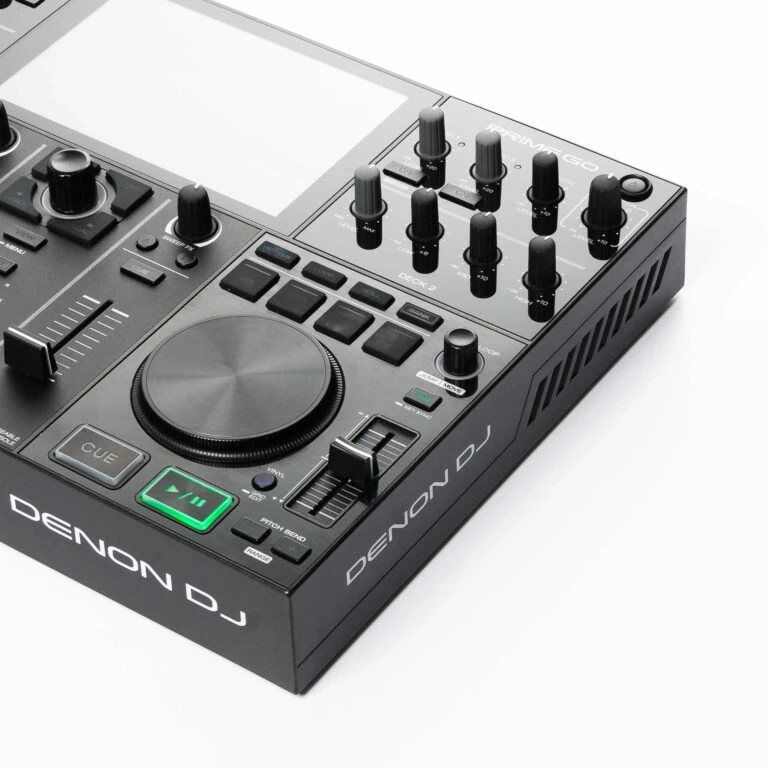
- 2 decks
- 7-inch touchscreen
- USB + SD card
- battery-powered
- Engine OS 3.x
What Alpha writes for the Prime Go
Alpha writes a standard Engine OS 3.x library straight onto the stick: the audio files, the interpreted metadata — BPM, musical key in Camelot notation, energy and loudness — and the playlist in exactly the order you built it. That is the format the whole Engine DJ family reads, so the drive plays the moment you plug it in. No Engine DJ desktop session, no re-analysis on the unit.
Before Alpha touches a stick that already has a library, it copies that library to your computer as a backup. Writing adds to what is on the drive — it never erases it — and a track that is already there is linked into the new playlist instead of being copied a second time. After writing, Alpha validates the result and lets you eject safely.
The Prime Go is a battery-powered two-deck standalone, and that is exactly the setup Alpha is built around: no laptop in the booth, just the unit and a prepared drive. It takes both USB sticks and SD cards, and the on-disk format Alpha writes is identical for either — point the export at whichever is mounted.
From folder to Prime Go in four steps
Good to know on the Prime Go
- This is the device every Alpha release is validated on — if something works anywhere, it works here first.
- The Prime Go re-analyzes nothing: Alpha's BPM, key and beatgrid are read as-is from the Engine library, so tracks are ready the moment they load.
- If a playlist shows up without waveforms at first, that's normal — the Prime Go draws its own waveform the first time it loads a track.
- Playing outdoors on battery? Prepare several playlists on one stick — Alpha adds to the Engine library on the drive, it never wipes it.
Common questions about the Prime Go
Do I need the Engine DJ desktop app to prepare a stick for the Prime Go?
No. Alpha writes the Engine OS 3.x library directly onto the drive — the Prime Go mounts it exactly like a stick prepared by Engine DJ itself, with playlists, BPM and key in place.
I'm coming from rekordbox — can the Prime Go use my rekordbox USB?
Engine OS can import a rekordbox stick on the device, but that import is slow and beatgrids can shift. The cleaner way: export your collection as a rekordbox XML, let Alpha keep the BPM, key and beatgrid rekordbox worked out, and write a native Engine library to the stick instead.
Can I use the Prime Go's SD card slot instead of a USB stick?
Yes. Point Alpha's export at the mounted SD card — the on-disk format is identical, so the Prime Go reads either the same way.
How should the stick be formatted for the Prime Go?
exFAT (Denon's recommendation) or FAT32 — Engine OS does not read NTFS. Alpha writes onto the stick's existing filesystem; it never reformats your drive.
Try it with your own Prime Go
Every feature is in the free download — analysis, harmonic sequencing, loudness matching and the Engine DJ write. It stops after 10 tracks, which is enough for one real set on your own stick. After that it's €30 including VAT, once. No subscription.
Related players
Different setup? Check your own gear — or read the full technical reference in the knowledge base.